Agate
Agate is a tool for creating, running, and reviewing data extraction and enrichment workflows. Teams use it to customize workflows and review the data they produce.
Three concepts to know
Agate executions revolve around three connected concepts:
| Concept | Definition |
|---|---|
| Flows | A series of steps composed of nodes that are wired together. You build it once and reuse it. |
| Runs | A single execution of a flow over one or more articles. |
| Processed items | A flow's output for one article: the people, places, metadata and other information extracted by the flow — which you can review and correct. |
Building flows
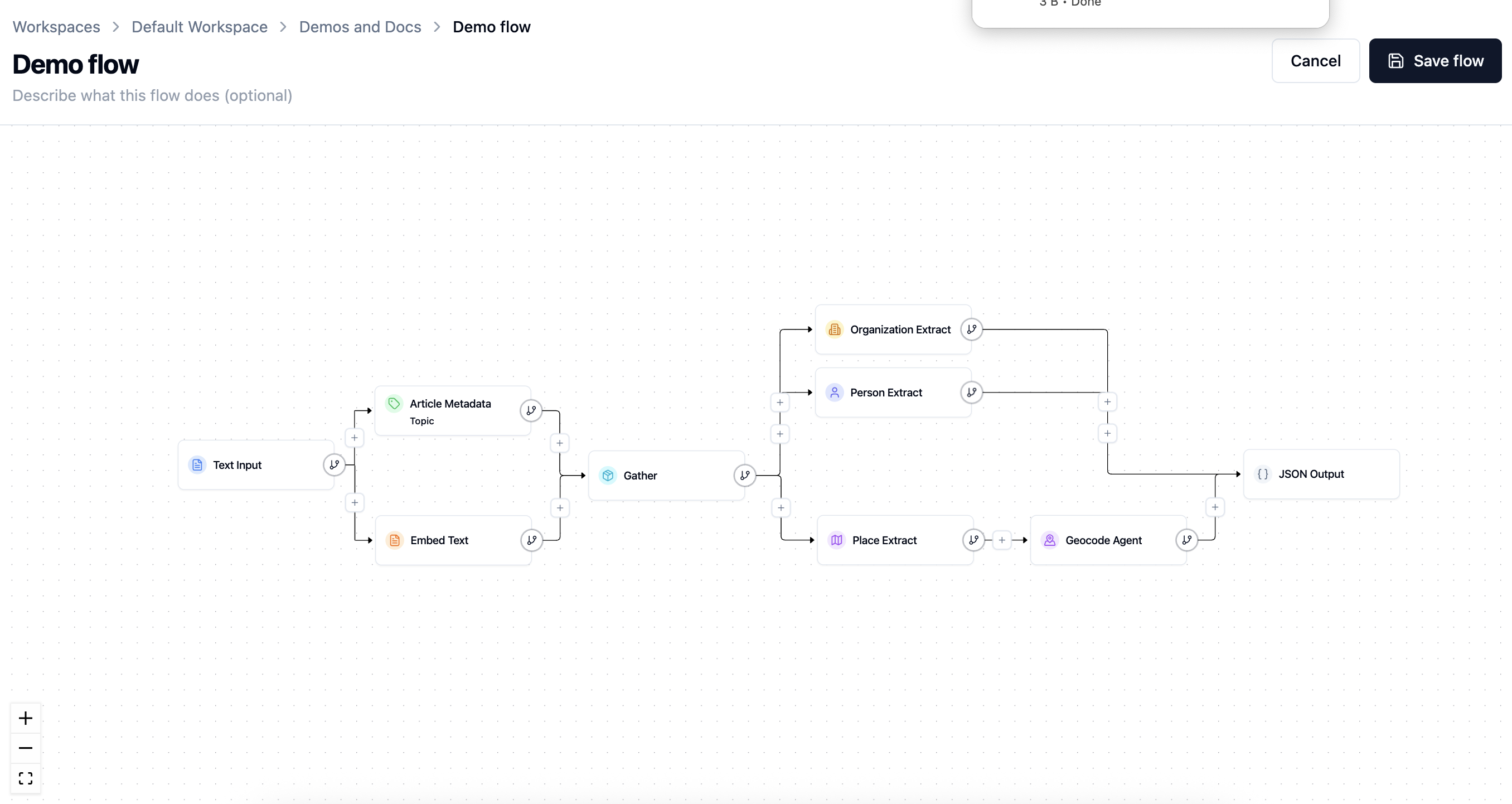
A flow is built from nodes. Each node does one job, such as assigning a topic, extracting people, or geocoding places. Agate's guided builder starts by asking for an input and an output, then offers compatible steps that can be inserted between them.
Nodes come in several types, and developers can create new ones for specific tasks. See the Nodes overview for the full catalog.
Running and reviewing
A flow is a reusable definition of an extraction or enrichment process. Starting it creates a run. Each article in that run becomes a processed item, where an editor can:
- compare extracted data with highlighted passages in the story;
- correct fields, remove mistakes, or add something the model missed;
- inspect geography and article metadata;
- compare original model output with reviewed output.
Completed runs keep their own snapshot of what executed. Editing the flow affects later runs rather than silently changing past results.
How Agate works with Stylebook
Agate either produces raw JSON (via JSON or S3 Output nodes) or sends its output into a shared Backfield database.
The Backfield Output node saves articles and structured results into the Backfield ecosystem. It always uses the Stylebook assigned to the project. As it saves, it can match each extracted person, organization, or place against that Stylebook, propose new records, and form supported connections.
This identity-matching process is known as canonicalization. The output step also controls how a rerun reconciles new machine output with data already saved for an article: add only, smart merge, or replace. Editor-created and editor-modified evidence is protected from automatic replacement.
Canonical matching can use deterministic rules and, when configured, guarded AI assistance. Uncertain decisions go to Stylebook for editorial review.
In this section
| Page | What it covers |
|---|---|
| Flows | Building and executing pipelines |
| Nodes | The building blocks, grouped by what they do |
| Runs | Running flows on one item or a batch, and tracking progress |
| Processed items | Reviewing and correcting results article by article |